



Tibetan Headlines
Apr 11: New Kashag Secretary
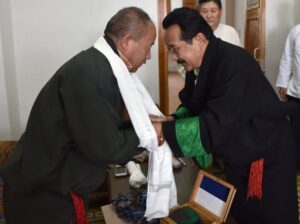
Tsegyal Chukya Dranyi has been appointed and taken over as the new Kashag Secretary and was given the three seals of his office: Kadam Sishey Dickyi which was given by HH the 7th Dalai Lama; Sertam and Taksam. He has served as Secretary of both the Department of Health and the Department of Religion and Culture.
Apr 11: US Support
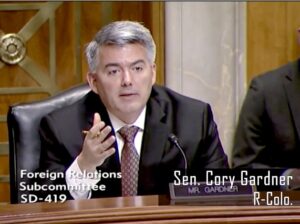
United States Senator Cory Gardner addressed a hearing of the US Senate Foreign Relations Subcommittee on East Asia, the Pacific, and International Cybersecurity Policy, saying that the US Congress affirms the sole, legitimate and indisputable authority of HH the Dalai Lama to determine his succession, and that the US will not recognise a Dalai Lama selected by the Chinese. China claims the right to select the Dalai Lama’s successor.
Apr 10: Minor Chest Infection
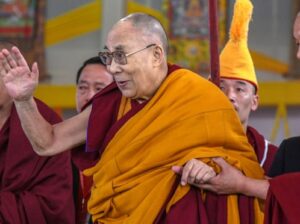
HH the Dalai Lama has flown to New Delhi suffering from a “minor chest infection” after contracting a cold, with a fever. His personal physician is reported as saying “There is no need to worry” and that he will be kept in for a few days for observation. His Holiness is at the Max Super Specialty hospital in Saket, South Delhi.
Apr 10: Sera Monks’ Directive
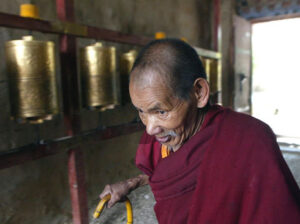
Monks at Sera Monastery in Lhasa, Tibet, have been ordered to “stand against separatism” and strictly follow Chinese laws. Lhakpa Tsering, a Tibetan official working for the Chinese administration in Tibet, announced the new directive at a press conference. Monks have been told to “repay China’s generosity” in Tibet with loyalty to Beijing and to “watch their behaviour online”, especially on social media platforms WeChat and Weibo.
Apr 9: Swine Fever in Tibet
The first ever case of African swine fever has been reported in the Tibet Autonomous Region (TAR). China’s Ministry of Agriculture and Rural Affairs confirmed the outbreak and said that the disease was found in two counties and one district in TAR, including the city of Linzhi near the border with India. African swine fever is believed to infect only pigs; no human or other species has been infected so far.
Apr 8: A State Secret
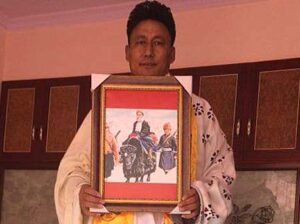
Lodoe Gyatso, 57 has been sentenced to 18 years in prison, becoming the longest serving Tibetan political prisoner. When asked about his recent sentencing, VOA has been reportedly told by an official at the Intermediate People's Court in Nagchu prefecture that it is “a state secret”. Gyatso was arrested after his solo protest in Lhasa on January 28, 2018. He was formerly arrested in 1991 and spent 21 years in prison.
Apr 5: Forced From Land
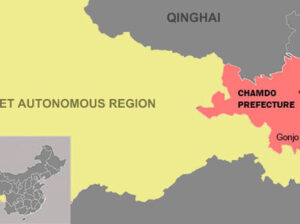
Tibetan villagers are being forced off their ancestral lands in Gonjo county in Chamdo prefecture by the Chinese authorities. Radio Free Asia has reported 12 families being taken away after resisting Chinese attempts to relocate them to Khonpo in the south, promising new housing and land - the Tibetans saying they did not trust the Chinese promises. This is the latest in a series of forced relocations in the area.
Apr 5: His Holiness Launches Conference
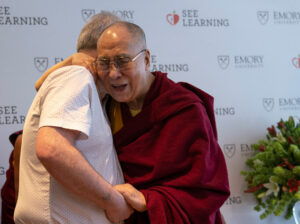
HH the Dalai Lama launched the Social, Emotional and Ethical Learning (SEE) conference in Delhi, a programme organised by Emory University in collaboration with the Dalai Lama Trust and the Vana Foundation. SEE emphasises the cultivation of compassion for self and others, resilience skills based on trauma-informed care, system thinking and ethical discernment. Secular Ethics is to be incorporated into the schools curriculum by the Delhi government.
Apr 4: Book Launch
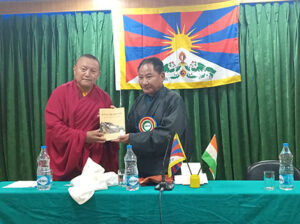
Former political prisoner Ven Bagdro has launched his 15th book, Bodh Bodhyul dhu Kyi, Gya Gyayul dhu Kyi, which, he said, was motivated by an incident which happened during a talk he gave in the United States in 1997 when around 40 Chinese students interrupted him, saying that Tibet was a part of China. He promised to write a book to prove Tibet’s independence.
Apr 4: Brief for UN
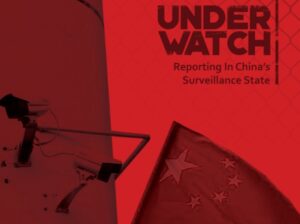
The Foreign Correspondents Club of China has released a brief to the United Nations Special Rapporteur on tate surveillance of journalists in China summarising the “rapidly expanding surveillance in China and government interference with reporting”, with particular reference to the restrictions in place in Tibet and East Turkestan, or Xinjiang. The UN Special Rapporteur is expected to report to the General Assembly in October 2019.
Apr 3: New Initiative
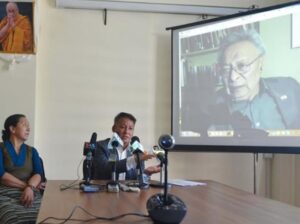
The Youth Employment for Tibetans Initiative has been launched by Tibet Innovations in collaboration with the Central Tibetan Administration’s Tibetan Entrepreneurship Development and Tibet House Trust, London. The new major initiative is a business contest aimed at finding a Tibetan entrepreneur with the vision and skills to create a sustainable business employing young Tibetans in an Indian settlement.
Apr 2: New Power Station
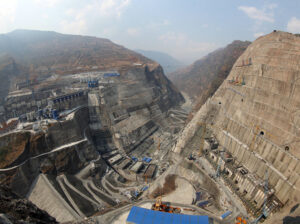
Construction has started on a major new 2.24-GW hydropower station on the Yangtze River in the Tibet Autonomous Region, reports Chinese state media Xinhua, saying that the station will significantly reduce carbon dioxide emissions and that more than 1.5 billion yuan will be invested in environmental protection projects. 240 km of new access roads have already been constructed. 13 hydropower stations are planned for the region.
Apr 1: Play Goes Ahead

Pah-la, the play by award winning playwright Abhishek Majumdar, about a Tibetan nun who self-immolated during the 2008 uprising in occupied Tibet, is to be staged in London UK at the Royal Court. It was cancelled last year to appease the Chinese. The UK Tibetan community says the theatre has not auditioned any Tibetans for the cast, but expects them to help with media coverage, costumes, props, etc.
Apr 1: Support from America
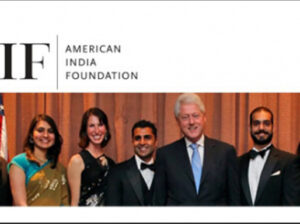
The American Indian Foundation (AIF), a nonprofit organisation working to accelerate social and economic change in India, has pledged support by funding two of their fellows to work with the Central Tibetan Administration’s Social and Resource Development Fund (SARD) for of ten months from September this year. The New York-based AIF is was co-founded by former US President Bill Clinton. The fellows will be young American or Indian citizens.
Apr 1: Party Loyalty
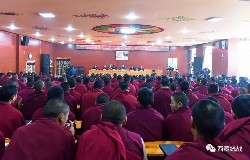
The Communist Party of China held a press conference at Sera Monastery in Lhasa - one of the most prominent Buddhist monasteries - instructing monks and managers to show loyalty to the Communist party of China; to stand against separatism; to practice their faith “patriotically” and abide by the Chinese government’s laws. 20 prohibitions included avoiding use of networking to organise, participate or incite the subversion of country.